James Hardie Junior ADU Conversion: The Long Beach Owner’s Guide
If you’re planning a junior ADU conversion on a Long Beach property and want James Hardie siding or trim as part of the build, we stock and install the complete HardiePlank, HardiePanel, and HardieTrim lines needed to match your existing home. A typical James Hardie-clad junior ADU conversion in Long Beach runs $85,000 to $145,000 all-in, depending on whether you’re converting attached garage space, a detached structure, or building new. Most homeowners discover they need Hardie-specific work when the siding on an existing structure shows swelling at the bottom edge, cracked boards near the foundation, or trim pulling away from corners after a few wet winters.
The good news: James Hardie products are fiber cement, which holds up far better than wood in Long Beach’s marine air. The less-good news: when they do fail, it’s usually an installation issue rather than a product defect, and the fix requires someone who knows how Hardie products behave at specific clearances, fastener depths, and joint patterns. We’re an independent Long Beach contractor, not affiliated with James Hardie, but we’ve built and converted enough of these structures to know exactly what fails and why.
Which James Hardie Models This Applies To
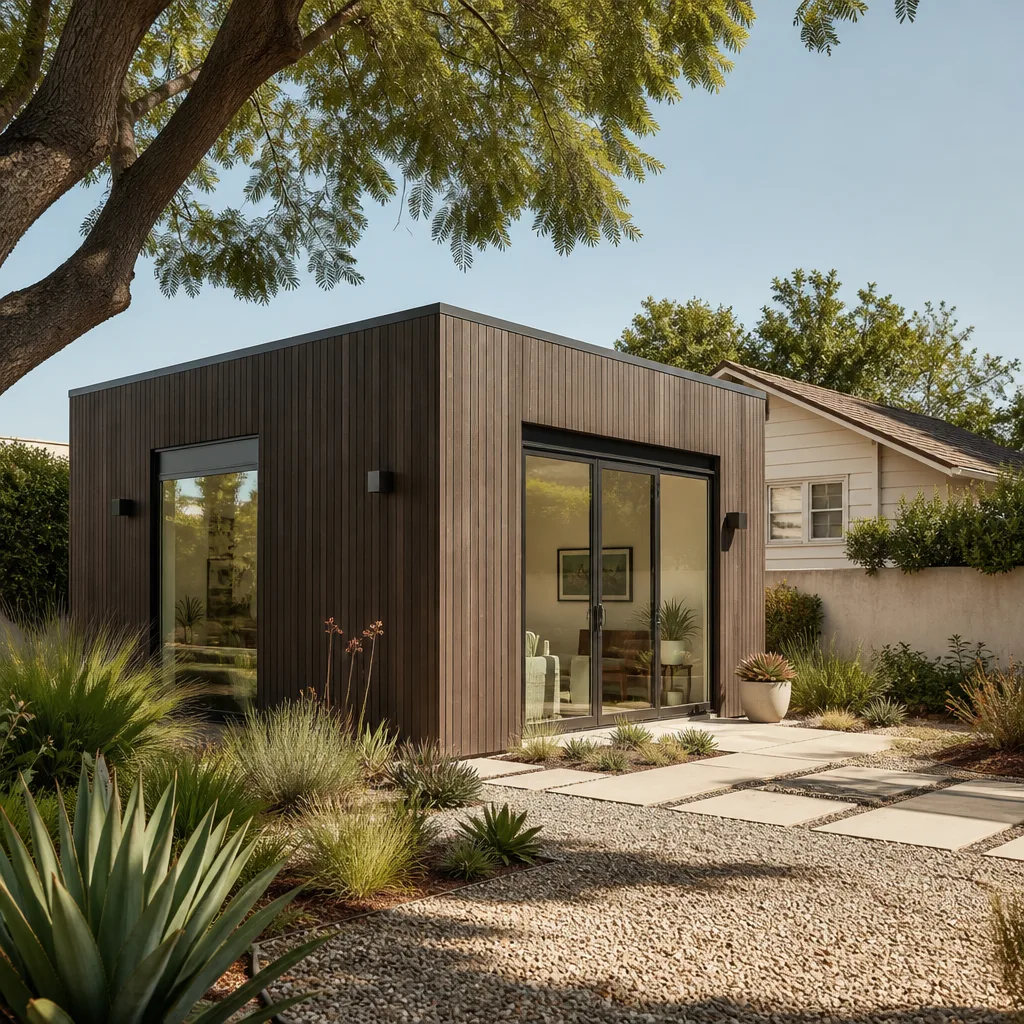
The junior ADU conversion work we do in Long Beach typically involves three Hardie product families. HardiePlank lap siding comes in 4×8, 5.25-inch, 6.25-inch, 7.25-inch, and 8.25-inch exposures, with the 6.25-inch exposure being the easiest match to older Long Beach homes built from the 1940s through the 1980s. HardiePanel vertical siding comes in 4×8, 4×9, and 4×10 sheets, with the 4×8 being the standard for most junior ADU exterior walls. HardieTrim boards come in 1×4, 1×6, 1×8, and 5/4 x 4 through 5/4 x 12 sizes, and these are the pieces that fail first on ADUs because they sit at the roofline and corners where water collects.
Here’s the compatibility gotcha most Long Beach homeowners don’t know: Hardie products are not interchangeable between textured finishes. If your home has a cedar grain texture on the original siding, the smooth HardiePanel you ordered online won’t match visually, even if the paint color is identical. You need to match the texture profile before you match the paint. Additionally, Hardie siding must sit at least 6 inches above finished grade on Long Beach soil, or the bottom edge absorbs moisture from irrigation overspray and fails prematurely. We see this constantly on garage conversions where the original slab sits low and the siding was run too close to the ground.
For OEM versus aftermarket: James Hardie only sells through authorized dealers, so OEM Hardie products are the standard. The aftermarket market is mostly for trim accessories like flashing, corner boards, and caulking. We use Hardie-recommended flashing systems rather than generic substitutes because the warranty stays valid that way, and because we’ve seen generic aluminum flashing corrode against fiber cement in Long Beach salt air within three years.
Signs Your James Hardie Junior ADU Conversion Is Failing
- Swelling or bubbling at the bottom 6 inches of the siding. This means water is wicking up from soil contact, sprinkler overspray, or a slab that’s too low. The fiber cement is absorbing moisture, and once it swells, the board must be replaced, not repainted.
- Cracked boards running diagonally from a fastener. Hardie siding cracks when a nail is driven too deep or when the board was forced against an uneven stud. The crack will grow with Long Beach’s temperature swings, and water will find the seam behind the paint.
- Trim separating from the corner or roofline, with a visible gap. This is a flashing failure, not a trim failure. Water is getting behind the trim and pushing it open. Re-caulking alone never works for more than a season.
- Paint peeling in a clean horizontal line halfway up the wall. Hardie siding holds paint for 15 to 20 years in Long Beach’s moderate climate, so early peeling is almost always a moisture problem behind the board, not a paint failure.
- A powdery white residue on the bottom edge of the board. That’s efflorescence from salt and mineral exposure. It’s especially common on ADUs closer than a quarter mile to the water in Belmont Shore, Naples, or the Peninsula, and it signals that the board’s sealant has broken down.
Replacement Cost & What’s Included
A James Hardie siding or trim replacement on a junior ADU in Long Beach runs $4,500 to $18,000 depending on how much of the structure is affected. A single wall of HardiePlank replacement with proper flashing typically falls between $4,500 and $8,500. A full re-side of a 400 to 600 square foot junior ADU with HardiePlank and new trim runs $14,000 to $18,000. The price includes the removal of the failed boards, inspection of the underlying weather barrier, replacement of any damaged flashing, installation of the new Hardie product to spec, caulking, and painting.
| Scope | Typical Long Beach Price Range |
|---|---|
| Spot repair: 1-2 HardiePlank boards and flashing | $450 – $950 |
| Single wall replacement (100-150 sq ft) | $4,500 – $8,500 |
| Full junior ADU re-side (400-600 sq ft) | $14,000 – $18,000 |
| Trim-only replacement around roofline and corners | $2,800 – $6,000 |
What drives the range: access (a second-story dormer costs more than a ground-floor wall), the condition of the framing behind the siding, whether we need to re-flash windows and doors, and whether the Long Beach building inspector requires additional structural review for the conversion. Every Seedling project gets a written price before any work starts, no change orders added later, and every job is covered by our 365-Day Done Right Promise. If it’s not done right, we make it right.
DIY or Call Us?
You can safely check a few things yourself: look for the visible gaps, swelling, and cracking described above, and note whether your sprinkler heads are spraying directly onto the siding. That observation will save you money regardless of who does the repair. What you should not do is pull a Hardie board off the wall yourself. Fiber cement creates silica dust when cut, broken, or drilled, and a board that’s let go of its fasteners can slide down the wall and take out a window or a person underneath. Removing siding also exposes the weather barrier, and if that gets damaged in the process, you’ve turned a $450 spot repair into a $4,500 water intrusion claim. Ben Ortega has walked these jobs on Long Beach properties for over a decade, and he’ll tell you the same thing he tells every homeowner: “Tell me what you need the space to do, and we’ll work backward from there.” If you want a trained set of eyes on it before you spend anything, call us at (562) 362-4592 and we’ll take a look.
FAQs
HardiePlank and HardiePanel typically last 30 to 50 years in Long Beach’s climate, assuming the original installation kept proper clearances and the paint is maintained every 15 years or so. Poor installation can cut that to as little as 8 to 10 years before visible failure starts.
A hairline crack that hasn’t let water behind the board can sometimes be sealed and repainted, but any crack wide enough to catch a fingernail requires board replacement. Once Long Beach moisture gets behind the board, the framing and weather barrier start degrading, and no amount of caulk or patch works long-term. Call us at (562) 362-4592 for an honest assessment.
A single wall or spot repair is typically a one-day job. A full junior ADU re-side takes three to five working days, depending on how much trim and flashing needs to be replaced. We schedule work around your family’s routine, and the crew uses shoe covers and drop cloths inside the home if any interior access is needed.
We keep the most common HardiePlank exposures, HardiePanel sheets, and HardieTrim profiles in our Long Beach inventory, and we can source any specialty texture or color-matched board through our local James Hardie dealer within a few days. We also work with Abodu, Cover, and Dvele prefab systems when your junior ADU uses those panel products.
Written by Ben Ortega, Owner, Seedling ADU Long Beach at Seedling ADU Long Beach, serving Long Beach and nearby areas.